

It’s November. Your benefits team is juggling open enrollment files, carrier portals, eligibility changes and a renewal pile that grows every morning. Clients want answers today, not next week.
This is the season when strong employee benefits administration makes or breaks your service. Tammina Insurance Services works as an extra set of trained hands inside your agency. Your people stay close to clients while the paperwork keeps moving.
Below, we cover what this support looks like, why 2026 feels heavier, how it works, what it costs and how to pick the right partner. Each section starts with a quick answer, so you can skim or dig in.
What Is Employee Benefits Administration Support?
It means a trained partner team takes on the day-to-day processing behind group benefits, working as an extension of your agency. Your agency still owns the client relationship, the advice and the decisions. The partner handles the processing, on your deadlines and in your systems.
For a benefits agency or broker, that work often includes:
- Enrollment and open enrollment data entry
- Eligibility adds, changes and terminations with carriers
- Billing reconciliation and invoice checks
- Renewal preparation, census cleanup and plan comparisons
- Life event changes and continuation coverage notices
- Keeping your agency management system accurate and current
Tammina’s employee benefits support services cover each of these tasks, from the first enrollment file to the final renewal summary.
Who is it for? Independent agencies, regional brokers, benefits consultants, managing general agents with group products and carriers that support broker channels. It fits a ten-person agency in Ohio just as well as a large brokerage with offices from Toronto to Texas. If you run an agency or brokerage, our page for agents and brokers shows how this support plugs into your daily work.
Why Are Agencies and Brokers Feeling the Squeeze in 2026?
Costs are climbing fast, and every rise creates more work for benefits teams. Higher prices push employers to change plans, request more quotes and ask more questions.
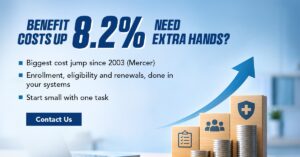
Mercer’s early survey of more than 1,800 employers in the United States, released in September 2026, found that total health benefit cost per employee is expected to rise 8.2% on average in 2027. That is the highest increase since 2003. Without any action, employers said the cost of their current plans would climb 11% on average. (Mercer)
Those plan changes land on your desk. Mercer reports that 59% of employers plan cost-cutting changes to health benefits in 2027, such as higher deductibles. Each change brings new rates, new forms and new enrollment files to process. (Mercer)
Complexity is the second pressure point. In a March 2026 survey of 170 brokers by the Employee Benefit Research Institute, nearly half named administrative complexity as a core challenge when adding supplemental health products. The same survey found that 77% of brokers expect health insurance sales to grow next year. (Employee Benefit Research Institute)
More sales plus more complexity is a heavy mix. A 2026 survey of 166 benefits brokers and leaders by The Council of Insurance Agents & Brokers found that clients use three to four point solutions on average. Every extra vendor adds another portal, another file feed and another place where data can break. (Leader’s Edge)
Employees feel the strain too. BenefitHub’s October 2026 survey of nearly 13,000 workers in the United States found that nearly eight in ten spend an hour or less choosing benefits. Rushed choices often lead to corrections after the enrollment window closes, and those corrections come back to your team. (BenefitHub)
How Does Employee Benefits Administration Support Work, and What Does It Cost?
The best setup feels like a quiet extension of your own team. A good partner logs into your systems, follows your workflows and returns clean work on agreed deadlines.
Here is how a typical rollout runs at Tammina Insurance Services:
- Discovery call. We map your benefits tasks, volumes, carriers and peak seasons.
- Process playbook. We write down each task step by step, including your naming rules and quality checks.
- Secure access. Our specialists work inside your agency management system, such as Applied Epic, Vertafore or HawkSoft, plus your carrier portals.
- Pilot. We start with one task, such as eligibility changes, and track speed and accuracy.
- Scale up. Once the pilot hits your targets, we add renewals, billing checks or open enrollment support. Our insurance renewal processing team often joins at this stage.
What does it cost?
Pricing depends on what you send, how much of it and how fast you need it back. Most partners use one of three models:
- Per task: you pay for each enrollment, change or reconciliation. This suits uneven volume.
- Per employee per month: common when a partner runs full administration for a group.
- Dedicated specialist: a trained team member works your accounts full time. This suits steady, high volume.
Volume, number of carriers, turnaround time and system access all shape the final number. Ask for a pilot, so you can judge value with real work before you commit.
What are the benefits?
- Faster turnaround during open enrollment and renewal season
- Fewer data errors, thanks to multi-level quality checks
- Extra capacity for peak months without a long ramp-up
- More time for account managers to advise clients and win new groups
- Longer working hours that cover clients from the East Coast to the West Coast
Timing matters here. In the United States, many employer open enrollment windows run from October through December for plans that start on January 1. Many Canadian group plans renew on their own anniversary dates, so busy months can stack up all year. A partner that scales up for each peak keeps your service steady through all of them.
How Do You Choose the Right Benefits Partner?
Pick a partner that knows insurance, not just data entry. Benefits work has its own language, deadlines and compliance rules, and a general vendor will learn them on your time.
Use this quick checklist:
- Insurance focus. Ask how many benefits clients they support and which carriers they know.
- System experience. They should already work in your agency management system.
- Quality control. Look for at least two levels of review before work comes back to you.
- Data security. Ask about access controls, secure networks and privacy training.
- Clear service levels. Turnaround times should be in writing and reported every month.
- Room to grow. Peak season should not need a new contract.
Mistakes to avoid
- Sending every task on day one instead of starting with a pilot
- Skipping the process playbook, which leads to guesswork and rework
- Choosing on price alone and paying for it later in corrections
- Keeping your team out of the loop. The best results come when your staff and your partner work as one team.
Comparing your options
Most agencies weigh three approaches:
- Benefits software alone automates parts of enrollment. Someone still has to check data, chase carriers and fix errors.
- A general data-entry vendor offers people, but often without insurance training.
- An insurance operations partner brings trained specialists who work inside your software and know carrier rules.
Many agencies pair their benefits software with a specialist partner to get the most from both.
Frequently Asked Questions
What is employee benefits administration support?
It is when an agency, broker or employer brings in a trained partner team to handle routine benefits tasks, such as enrollment, eligibility changes and billing checks. The agency keeps the client relationship and every key decision.
Why do agencies bring in a benefits support partner?
Agencies do it to add capacity during busy seasons, cut data errors and free account managers for client service and growth. It helps teams handle rising volume without slowing service.
Are there risks in working with an outside benefits team?
Yes, if the partner lacks insurance training or strong data security. You can lower the risk with a pilot, written service levels, secure system access and regular quality reports.
How long does it take to get started?
It depends on your task list and system access. Tammina begins with a short discovery call and a pilot on one task, then expands once results meet your targets.
Does Tammina support agencies in Canada?
Yes. Tammina Insurance Services supports agencies, brokers, managing general agents and carriers across the United States and Canada, working inside the systems they already use.
Ready to Make Open Enrollment Easier?
Rising costs, more plan changes and tighter deadlines are here to stay. The agencies that grow in 2027 will give their people room to advise, sell and build relationships.
The right employee benefits administration partner gives you that room. Tammina Insurance Services adds trained, insurance-focused specialists to your team. They work in your systems, on your deadlines, with support from our headquarters in Chantilly, Virginia, for clients across North America.